
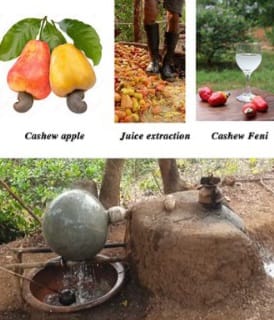
The name “feni” is derived from the Sanskrit word phena which actually means froth, Feni is a traditional liquor distilled from the fermented juice of cashew, safe to drink and free from artificial flavors
It is due to the fact that bubbles form a light froth when the liquor is shaken in a bottle or poured in a glass.
Feni is a part of Goa food tradition from the last 400 years.
Unlike other liquors, it rarely give you a hangover,
The Goan government initiated the process of declaring it as a heritage drink in 2016, It also got the Geographical Indication certificate in 2009.
Feni distillation is a traditional, two-step process in Goa using cashew apples or coconut sap. First, the fermented juice is distilled into a weak spirit called urrak. Next, this urrak is distilled a second time, separating the harsh “heads” and “tails,” to yield the final, high-proof heritage feni
Harvesting and Crushing
The process begins with ripe, naturally fallen cashew apples (or collected coconut sap, known as toddy). The cashew apples are sorted, their nuts are detached, and the fruit is placed into a large, rock-cut basin called a colmbi. Traditionally, farmers stomp the fruit with their feet to crush it and release the juice, while some modern setups use mechanical basket presses
Fermentation
The extracted juice is allowed to ferment naturally without any added yeast. The juice is kept in large earthenware pots (koddem) buried in the ground or in large plastic barrels. Fermentation typically lasts for 3 to 4 days, or up to 8–10 days in some areas, until the juice stops bubbling
First Distillationi
The fermented juice is transferred to a traditional copper still, historically heated over an open wood fire,, As the juice boils, the vapor travels through a hollow bamboo or metal pipe submerged in a cold water tank (condenser), the first distillate that drips out is a light, fruity alcohol with about 15–16% ABV, known locally as urrak
Second Distillation: Feni
To make feni, the urrak undergoes a second distillation in the same copper pot still, often mixed with a little water or more cashew juice to prevent burning
Distillers carefully discard the first few drops (the “heads” or impurities) and the final weak vapors (the “tails”).
The resulting middle-cut liquid is the potent feni, which typically has an alcohol content of 42% to 45% ABV.
Aging and Bottling
Once the feni is distilled, it is traditionally stored in massive, large glass carboys or clay pots. The spirit mellows over a couple of months, allowing the fruity, earthy aromas of the cashew apple to mature before it is bottled and sold.